
1983
Family Systems Medicine Journal Founded

Don Bloch, MD, Barry Dym, PhD, Michael Glenn, MD, and Don Ransom, PhD, founded Family Systems Medicine, creating one of the first scholarly homes dedicated to integrating family systems, medicine, and behavioral health. This provided an interdisciplinary platform for exploring the integration of family systems theory and healthcare. This journal would later become Families, Systems, & Health.
1983
Family Therapy and Family Medicine Is Published

William Doherty, PhD and Macaran Baird, MD published Family Therapy and Family Medicine: Toward the Primary Care of Families.
1984
Cherokee Launches Integrated Primary Care

Cherokee Mental Health Center launched its first primary care clinic in Blaine, TN. In 1987, it expanded to Knoxville, TN, after being asked by federal representatives to take over management of an existing health center.
1986
Advancing Systems Thinking
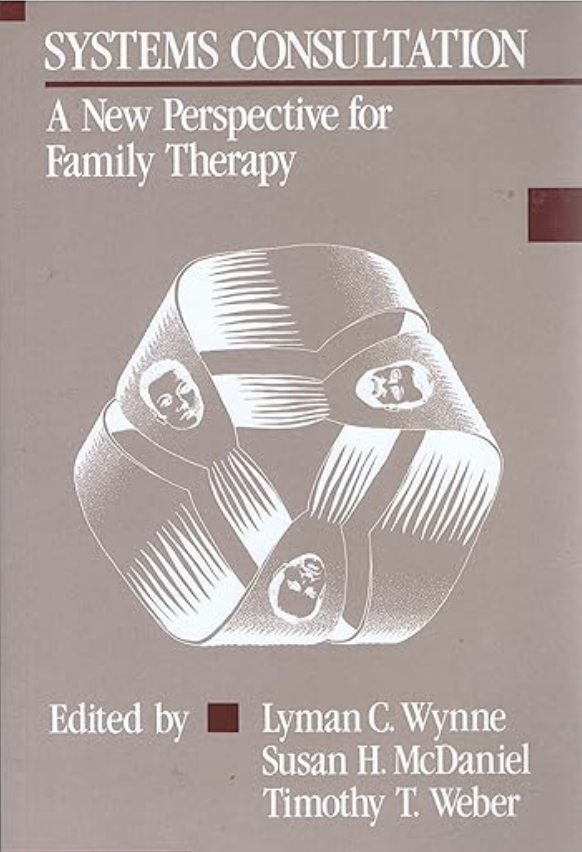
Systems Consultation: A New Perspective for Family Therapy, edited by Susan McDaniel, Thomas Weber, and Lyman C. Wynne offered a groundbreaking framework for applying systems thinking to clinical consultation and family therapy.
1988
Early Integrated Care Models Emerge

Patricia Robinson, PhD, and Kirk Strosahl, PhD, began early experiments in integrating behavioral health into primary care. Around the same time, Wayne Katon, MD, introduced foundational ideas for a collaborative approach to treating depression in primary care.
1992
Medical Family Therapy Takes Shape

Susan McDaniel, PhD, Jeri Hepworth, PhD, and William Doherty, PhD, published Medical Family Therapy: A Biopsychosocial Approach to Families with Health Problems, introducing a foundational model for integrating family systems and behavioral health into medical care.
1994
Wingspread Conference Convened

Approximately two dozen national leaders gathered at the Johnson Foundation’s Wingspread Conference in Racine, Wisconsin to create a national agenda for collaborative family healthcare—widely recognized as the event that launched what became CFHA.
1994
Collaborative Family Healthcare Coalition Formed & Working Together Newsletter Launches
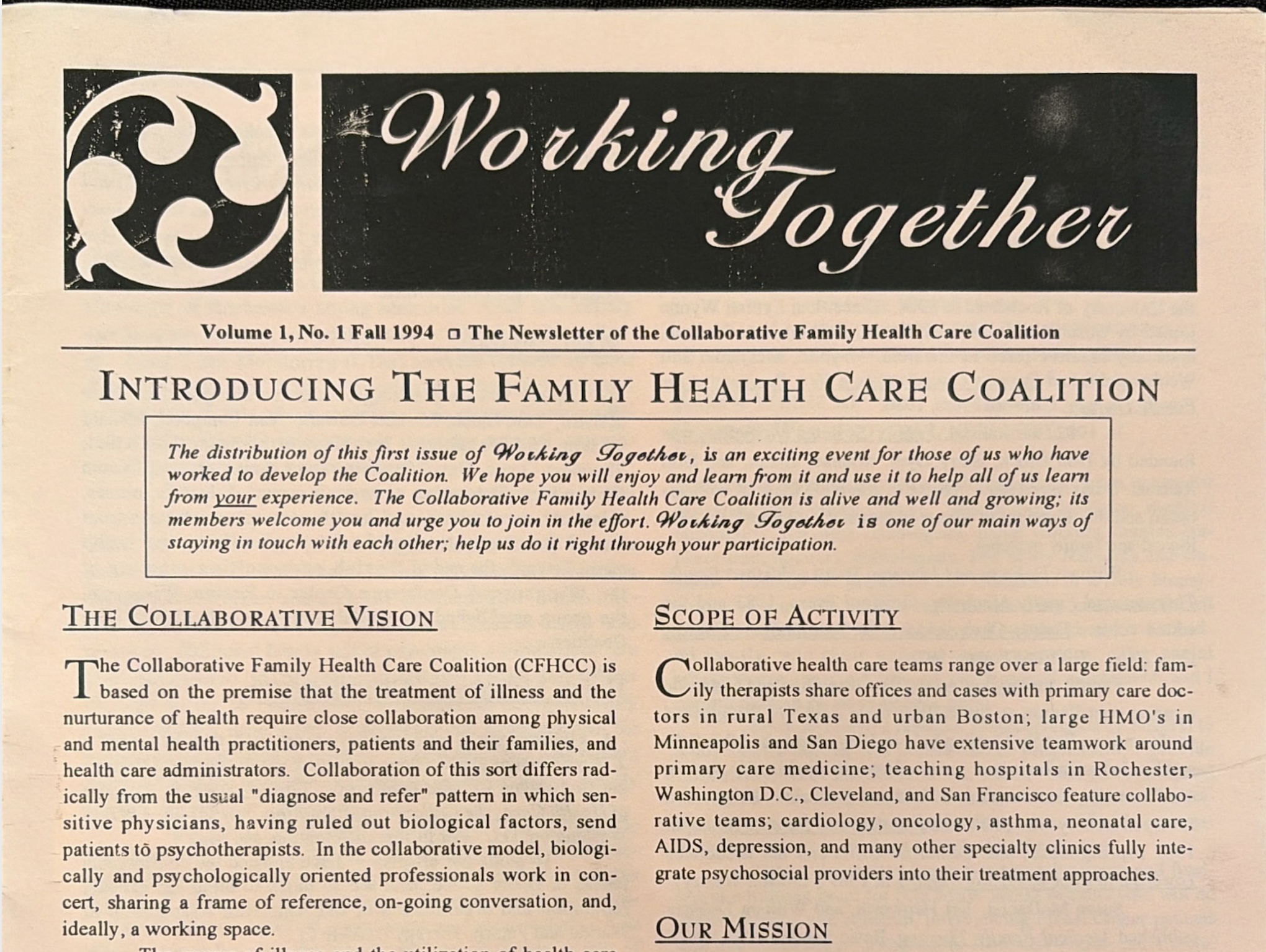
The energy generated at Wingspread led to the creation of the Collaborative Family Healthcare Coalition (CFHcC), an interdisciplinary organization designed to unite healthcare professions around integrated care.
In Fall 1994, CFHA published its very first newsletter, written and printed under the name Collaborative Family Health Care Coalition. This inaugural publication marked an early commitment to sharing knowledge, building community, and advancing collaborative approaches to family-centered health care.
1995
CFHcC Incorporated & The First Conference

In May of 1995, the Collaborative Family Healthcare Coalition was officially incorporated in New York State, establishing the organization legally. Later on in July of that year, CFHcC hosted its inaugural national conference, Transforming the Practice of Health Care: The Collaborative Solution, in Washington, D.C., attracting a remarkably strong national and international audience.
1995
Journal Renamed & the Organization Grew

After 13 years as editor, Don Bloch passed leadership of Family Systems Medicine to Susan McDaniel and Tom Campbell. The journal was renamed Families, Systems, & Health.
Within the organization’s first year, 22 local chapters had formed, including groups in London, Tel Aviv, and Freiburg, Germany, demonstrating rapid international growth.
1996
Foundational Models Take Shape

Kirk Strosahl, PhD, publishes Primary Mental Health Care: A New Paradigm for Achieving Health and Behavioral Health Integration in Behavioral Health Tomorrow, laying early groundwork for integrated care models. That same year, the first-ever guidelines for levels of integration are published by William Doherty, PhD, Melinda Baird, PhD, and Susan McDaniel, PhD—establishing a foundational framework still used in the field today.
1998
501(c)(3) Status Granted & Joint Conference with STFM

In March 1998, CFHcC received official nonprofit (501(c)(3)) status, strengthening the organization’s long-term foundation. That year, CFHcC partnered with the Society of Teachers of Family Medicine for a joint conference, strengthening ties between family medicine and integrated care.
2000
Organization Renamed CFHA

The Collaborative Family Healthcare Coalition officially became the Collaborative Family Healthcare Association, reflecting its evolution from an advocacy coalition into a professional home for the integrated care community.
2002

The U.S. Department of Veterans Affairs (VA) launches its first Primary Care Behavioral Health (PCBH) implementation program, marking a major step toward integrated care within a large federal healthcare system.
2002 - 2003
Organization Survives Financial Crisis

Following declining membership and conference attendance after 9/11, the Board considered dissolving the organization but instead chose to “leave the pilot light on,” preserving CFHA until it could rebuild.
2004
Strategic Planning for the Field

At the Minnesota conference, attendees collectively identified the next developmental priorities for integrated care, producing a roadmap that guided CFHA’s future work in implementation, education, policy, and research.
2005
Organizational Revival

Beginning with Seattle, CFHA introduced Regional Policy Summits as part of its annual conference strategy, expanding its influence beyond education into healthcare policy. The Seattle conference marked the organization’s resurgence after several financially difficult years and the beginning of sustained growth.
2013

The Agency for Healthcare Research and Quality (AHRQ), with scientific guidance from C.J. Peek and other integrated care experts, released The Lexicon for Behavioral Health and Primary Care Integration: Concepts and Definitions Developed by Expert Consensus. This document established a shared language for describing the core functions and principles of integrated care.
Around the same time, the Center for Integrated Health Solutions—supported by SAMHSA and HRSA—published A Standard Framework for Levels of Integrated Healthcare. This framework gave depth and structure to commonly used terms like coordinated, co-located, and integrated care, offering clear definitions along with descriptions of scope and complexity.
2018

The Journal of Clinical Psychology in Medical Settings published a special edition focused on the Primary Care Behavioral Health (PCBH) model, highlighting its growing influence and evidence base.
In the late 2010s and beyond, the AIMS Center at the University of Washington led national efforts to expand the Collaborative Care Model (CoCM), providing training, technical assistance, and research to support widespread implementation.
During this same period, the CFHA Board of Directors formally developed and published the organization’s Mission, Vision, and Values—solidifying its role as the professional home for integrated care.
2024

CFHA celebrated 30 years of advancing integration at the annual conference in San Antonio, TX. During the opening plenary session, CFHA President Deepu George, PhD, honored the organization’s luminaries in a special recognition ceremony, marking three decades of progress, partnership, and leadership in integrated care.