
Our Mission, Vision, & Values
Mission
CFHA supports healthcare professionals in integrating physical and behavioral health.
Vision
All healthcare teams provide patients and families an optimal and fully integrated experience in the pursuit of health and healing.
Values
- Fortifying a culture of humility and peer learning
- Nurturing relationships that form future leaders
- Disseminating and operationalizing evidence-based practices for patients and families who are at risk for health inequities through integrated care practice and policy
- Evolving with a growth mindset to promote adaptability and responsiveness
- Lifting every voice by safeguarding belonging, dignity, and justice
Our members include:
- Behavioral health professionals (MFT/LMFTs, Psychologists, Social workers)
- Medical providers (MDs, DOs, Nurses, Medical Assistants, PAs, Psychiatrists)
- Allied health professionals (Occupational therapists, Physical therapists, Dietitians, Nutritionists, Health administration, Pharmacists)
- Workforce development (Academic training programs)
- Organizational members (FQHC’s, Training programs, etc.)
- Public and population health
- Payors
- And more!
Our Strategic Plan
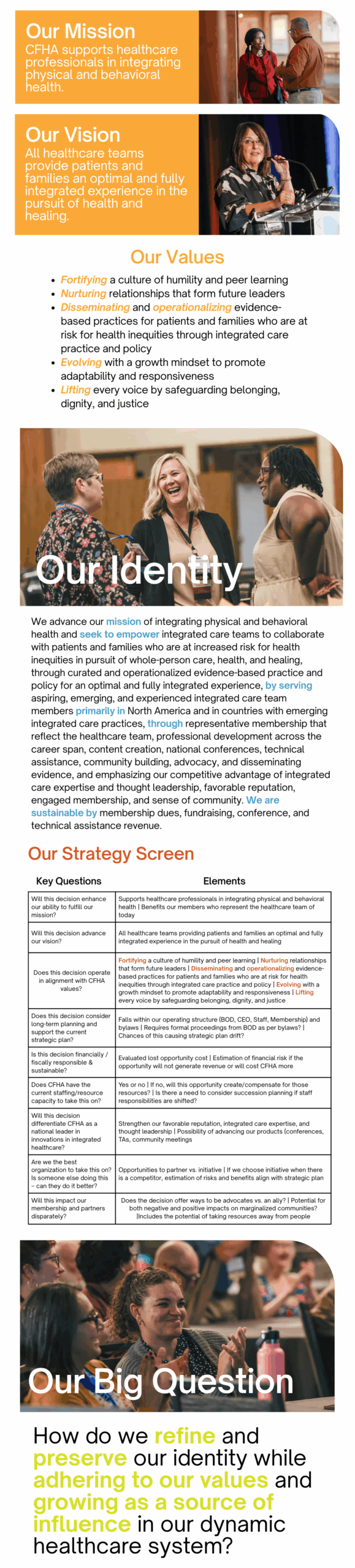
Our Three C’s
Our Collaborations
Collaboration is in our DNA. Here are just a few examples of how CFHA has partnered with other organizations.
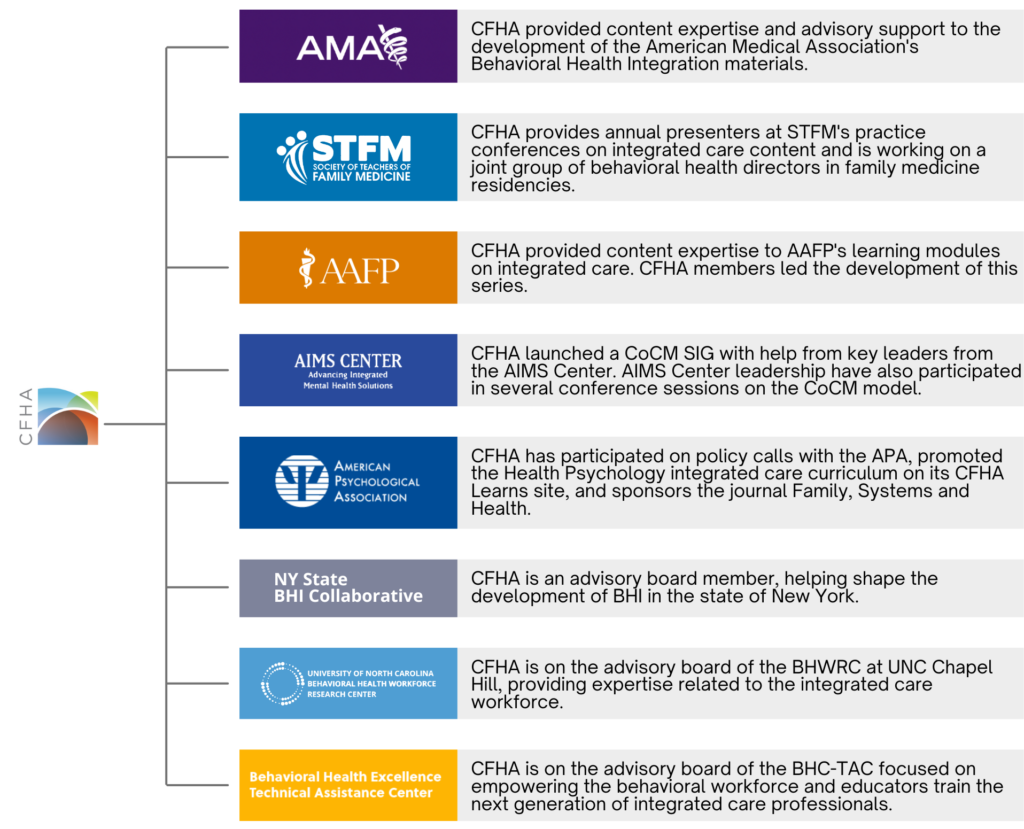
Our Partners
CFHA is a national organization that promotes integrated care, but we know that state and regional organizations do so much of the grass-roots work in this area every day. As a result, we want to highlight those organizations and the work that they do.

Arizona State University
The Doctor of Behavioral Health Program in the College of Health Solutions at ASU is an international education and training program designed to develop future leaders in integrated primary behavioral health care. DBH graduates develop, deliver, and evaluate programs that effectively transform healthcare systems.
Center of Excellence for Integrated Care
The Center of Excellence for Integrated Care, a program of the Foundation for Health Leadership and Innovation, helps to integrate physical and behavioral healthcare by providing health care clinics and systems with direct training, technical assistance, and other partnerships. The Center of Excellence team uses systematic tools and processes to help health care systems and clinics determine their current status and needs, while also providing the nuts and bolts technical assistance needed from the exam room to the board room.
Health Federation of Philadelphia
Health Federation of Philadelphia works to improve access to and quality of health and human services for vulnerable populations. One important example of our impact is the provision of consultation, program development, training and advocacy that enables a strong and expanding network of integrated care practices across the Greater Philadelphia region.

Center for Integrated Primary Care
The mission of the Center for Integrated Primary Care (CIPC) is to develop, synthesize and disseminate skills for best practices in the integration of Primary Care and Behavioral Health services so as to become a national leader in workforce development and practice-based research.
The CIPC is a part of the Department of Family Medicine and Community Health at the University of Massachusetts Medical School, a founding department of the University. The Center’s faculty are leaders in the integration of behavioral health and primary care. A central focus has been to teach the identification, assessment, and treatment of mental health and substance use disorders in primary care. Alumni of our programs number well over 3000 health care professionals across the globe.

St. Louis Behavioral Medicine Institute
St. Louis Behavioral Medicine Institute has an Integrated Care Consulting Team that provides training, consultation, and technical assistance for organizations integrating behavioral health into primary care settings.

Denver Health Integrated Behavioral Health Academy
Denver Health’s Integrated Behavioral Health Academy supports individual clinicians and medical practices in Colorado and beyond to help them achieve their behavioral health integration goals. We provide classroom training, practice coaching and consultation, and professional presentations.

Cherokee Health Systems
Cherokee Health Systems provides training to organizational leadership and clinical staff including medical and behavioral health providers on the model and execution of integrated care. Key topics include transformational change, team science, financial considerations, and operational strategies for maximizing not only access but also effective service delivery all with the quintuple aim in mind. These trainings are offered both in-house at CHS’ corporate office in Knoxville, TN, or off-site at the request of organizational leadership. These off-site trainings are tailored toward the organization’s needs and transformational goals.

Cummings Graduate Institute for Behavioral Health Studies
Cummings Graduate Institute of Behavioral Health Studies is a nonprofit, accredited, private institution offering online, post-graduate education in the field of integrated behavioral health, including the Doctor of Behavioral Health (DBH) degree exclusively focused in integrated care. The DBH program prepares integrated care professionals to best deliver whole-person healthcare to diverse communities and to improve access to quality healthcare for all.

Mental Health America of Greater Houston
Integrated health care – the coordination of physical and behavioral health care services – is a core component of MHA of Greater Houston’s work. Although physical and mental health is linked, our health care system has traditionally addressed them separately. Integrated health care aims to abolish this separation, an essential step in providing access to and normalizing behavioral health treatment. Through a collective impact approach, we advance sustainable integrated health care. Our work includes training and technical assistance, communities of practice, and implementation of collaborative efforts with primary and behavioral health providers, health systems, payors, and institutions of higher education, such as medical schools.

The Interprofessional Primary Care Institute
The Interprofessional Primary Care Institute (IPC Institute) is a collaborative learning community for healthcare learners & professionals. It promotes a diverse workforce and interprofessional teams focused on strengths and Strengthening Each Other™. The institute’s interprofessional team includes 60+directors & advisors from a variety of public, private & faith-based agencies. It is funded by the Healthy Oregon Workforce Training Opportunity Grant Program (HOWTO). HOWTO is administered under the direction of the Oregon Health Policy Board in partnership with the Oregon Health Authority and OHSU. For more information, visit www.ohsu.edu/howto.
Our Logo and Naming History
The Collaborative Family Healthcare Association (CFHA) has undergone several iterations of its visual identity over the years. Each version reflects our mission of supporting healthcare professionals in integrating physical and behavioral health.
Our Name
While we remain CFHA: The Collaborative Family Healthcare Association, we have adopted an elevated tagline that clarifies our role and mission.
Organizational Name
CFHA: Collaborative Family Healthcare Association
Elevated Tagline
CFHA – The Integrated Care Association
Our Logo
Our logo was designed to reflect who we are at our core: a member-based organization dedicated to supporting healthcare providers who deliver integrated care. Our current design now incorporates imagery of people, representing both our clinician members and the essential role of patients and their families in whole-person, team-based care.


This design honors our history, our name, and our mission by visually communicating our vision: that all healthcare teams provide patients and families with an optimal and fully integrated experience in the pursuit of health and healing.
The full updated CFHA Brand Guidelines can be found here.
Previous Logo Versions
Earlier versions of the CFHA logo served as strong visual identifiers of our mission and community. At the time, CFHA was rooted in grassroots convening and provider engagement, with less emphasis on structured marketing or formal brand strategy.

In contrast, our current logo is part of a more cohesive brand system that reflects a growing focus on intentional messaging and visual consistency.
One earlier logo dates back to when CFHA was known as the Collaborative Family Health Care Coalition. It is highlighted here in the first volume of the CFHA Newsletter.
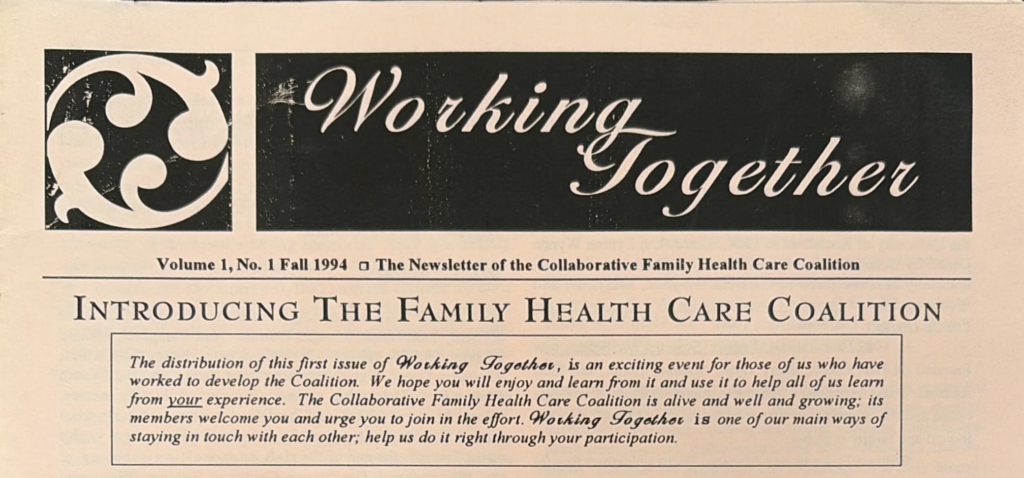
Our name and visual identity have evolved alongside our community, but our mission has remained constant: to champion integrated, whole-person care through community and collaboration.
Our History
- 1983

Family Systems Medicine Journal Founded
Don Bloch, MD, Barry Dym, PhD, Michael Glenn, MD, and Don Ransom, PhD, founded Family Systems Medicine, creating one of the first scholarly homes dedicated to integrating family systems, medicine, and behavioral health. This provided an interdisciplinary platform for exploring the integration of family systems theory and healthcare. This journal would later become Families, Systems, & Health.
- 1983

Family Therapy and Family Medicine Is Published
William Doherty, PhD and Macaran Baird, MD published Family Therapy and Family Medicine: Toward the Primary Care of Families.
- 1984
Cherokee Launches Integrated Primary Care
Cherokee Mental Health Center (now River Valley Health) launched its first primary care clinic in Blaine, TN. In 1987, it expanded to Knoxville, TN, after being asked by federal representatives to take over management of an existing health center.
- 1986

Advancing Systems Thinking
Systems Consultation: A New Perspective for Family Therapy, edited by Susan McDaniel, Thomas Weber, and Lyman C. Wynne offered a groundbreaking framework for applying systems thinking to clinical consultation and family therapy.
- 1988

Early Integrated Care Models Emerge
Patricia Robinson, PhD, and Kirk Strosahl, PhD, began early experiments in integrating behavioral health into primary care. Around the same time, Wayne Katon, MD, introduced foundational ideas for a collaborative approach to treating depression in primary care.
- 1992

Medical Family Therapy Takes Shape
Susan McDaniel, PhD, Jeri Hepworth, PhD, and William Doherty, PhD, published Medical Family Therapy: A Biopsychosocial Approach to Families with Health Problems, introducing a foundational model for integrating family systems and behavioral health into medical care.
- 1994

Wingspread Conference Convened
Approximately two dozen national leaders gathered at the Johnson Foundation’s Wingspread Conference in Racine, Wisconsin to create a national agenda for collaborative family healthcare—widely recognized as the event that launched what became CFHA.
- 1994
Collaborative Family Healthcare Coalition Formed & Working Together Newsletter Launches
The energy generated at Wingspread led to the creation of the Collaborative Family Healthcare Coalition (CFHcC), an interdisciplinary organization designed to unite healthcare professions around integrated care.
In Fall 1994, CFHA published its very first newsletter, written and printed under the name Collaborative Family Health Care Coalition. This inaugural publication marked an early commitment to sharing knowledge, building community, and advancing collaborative approaches to family-centered health care.
- 1995

CFHcC Incorporated & Hosts First Conference
In May of 1995, the Collaborative Family Healthcare Coalition was officially incorporated in New York State, establishing the organization legally. Later on in July of that year, CFHcC hosted its inaugural national conference, Transforming the Practice of Health Care: The Collaborative Solution, in Washington, D.C., attracting a remarkably strong national and international audience.
- 1995

Journal Renamed & the Organization Grew
After 13 years as editor, Don Bloch passed leadership of Family Systems Medicine to Susan McDaniel and Tom Campbell. The journal was renamed Families, Systems, & Health.
Within the organization’s first year, 22 local chapters had formed, including groups in London, Tel Aviv, and Freiburg, Germany, demonstrating rapid international growth.
- 1996

Foundational Models Take Shape
Kirk Strosahl, PhD, publishes Primary Mental Health Care: A New Paradigm for Achieving Health and Behavioral Health Integration in Behavioral Health Tomorrow, laying early groundwork for integrated care models. That same year, the first-ever guidelines for levels of integration are published by William Doherty, PhD, Melinda Baird, PhD, and Susan McDaniel, PhD—establishing a foundational framework still used in the field today.
- 1998

501(c)(3) Status Granted & Joint Conference with STFM
In March 1998, CFHcC received official nonprofit (501(c)(3)) status, strengthening the organization’s long-term foundation. That year, CFHcC partnered with the Society of Teachers of Family Medicine for a joint conference, strengthening ties between family medicine and integrated care.
- 2000

Organization Renamed CFHA
The Collaborative Family Healthcare Coalition officially became the Collaborative Family Healthcare Association, reflecting its evolution from an advocacy coalition into a professional home for the integrated care community.
- 2002

VA Launches PCBH Implementation Program
The U.S. Department of Veterans Affairs (VA) launches its first Primary Care Behavioral Health (PCBH) implementation program, marking a major step toward integrated care within a large federal healthcare system.
- 2002 – 2003

Organization Survives Financial Crisis
Following declining membership and conference attendance after 9/11, the Board considered dissolving the organization but instead chose to “leave the pilot light on,” preserving CFHA until it could rebuild.
- 2004

Strategic Planning for the Field
At the Minnesota conference, attendees collectively identified the next developmental priorities for integrated care, producing a roadmap that guided CFHA’s future work in implementation, education, policy, and research.
- 2005

Organizational Revival
Beginning with Seattle, CFHA introduced Regional Policy Summits as part of its annual conference strategy, expanding its influence beyond education into healthcare policy. The Seattle conference marked the organization’s resurgence after several financially difficult years and the beginning of sustained growth.
- 2013

A Shared Language for Integrated Care
The Agency for Healthcare Research and Quality (AHRQ), with scientific guidance from C.J. Peek and other integrated care experts, released The Lexicon for Behavioral Health and Primary Care Integration: Concepts and Definitions Developed by Expert Consensus. This document established a shared language for describing the core functions and principles of integrated care.
Around the same time, the Center for Integrated Health Solutions—supported by SAMHSA and HRSA—published A Standard Framework for Levels of Integrated Healthcare. This framework gave depth and structure to commonly used terms like coordinated, co-located, and integrated care, offering clear definitions along with descriptions of scope and complexity.
- 2014
20th Anniversary of Wingspread
CFHA returned to the Omni Shoreham Hotel in Washington, D.C.—the site of its first conference—to commemorate the 20th anniversary of the Wingspread Conference and reflect on two decades of progress.
- 2018

Integrated Care Models Gain Momentum
The Journal of Clinical Psychology in Medical Settings published a special edition focused on the Primary Care Behavioral Health (PCBH) model, highlighting its growing influence and evidence base.
In the late 2010s and beyond, the AIMS Center at the University of Washington led national efforts to expand the Collaborative Care Model (CoCM), providing training, technical assistance, and research to support widespread implementation.
During this same period, the CFHA Board of Directors formally developed and published the organization’s Mission, Vision, and Values—solidifying its role as the professional home for integrated care.
- 2024

CFHA Celebrates 30 Years
CFHA celebrated 30 years of advancing integration at the annual conference in San Antonio, TX. During the opening plenary session, CFHA President Deepu George, PhD, honored the organization’s luminaries in a special recognition ceremony, marking three decades of progress, partnership, and leadership in integrated care.